

FAST channels are growing faster than the workflows many teams use to program them.
Nielsen’s Gracenote analysis counted nearly 1,850 active FAST channels globally in 2025, with channel count up 76% since 2023. Comscore also reported that hours watched across major free ad-supported streaming services grew 43% year over year.
That growth creates a new operational reality for programming teams.
Viewers expect FAST channels to feel as polished as traditional television, with content that flows cleanly from one program to the next. They may not notice when the programming logic works well. They notice when it does not.
A slate screen lingers too long. The same promo appears again. A bumper feels out of place. A channel that should feel curated starts to feel like a playlist with gaps.
For programming and operations teams, those moments often come down to a simple but persistent issue: the scheduled block and the actual content runtime do not always line up.
A 52-minute episode needs to fit into a 60-minute block. A film leaves several minutes before the next scheduled program. A replay needs supporting content before, during, or after the main asset. Across one block, that gap may be manageable. Across a full linear schedule, those small gaps can create hours of avoidable slate and extra scheduling work.
Zype’s Playout Dynamic Blocks are designed for this reality. With Dynamic Block Builder, teams can anchor a block around a primary asset and automatically fill the remaining time with structured content pools, helping reduce fallback slate while keeping the channel experience more polished and intentional.
The Scheduling Problem Behind Fallback Slate
Fallback slate is often treated as a playback safeguard. In practice, it is usually a programming issue.
Slate appears when available airtime has not been filled with something more useful. That might be a promo, bumper, house ad, sponsorship asset, trailer, or another approved piece of content.
The issue is rarely a lack of assets. Most teams have content they could use.
The harder part is deciding which asset should run, where it should appear, how often it should repeat, and whether the final block will play as expected.
Those decisions become more complicated as channels scale. A manual fix that works for one block is harder to sustain across multiple channels, dayparts, campaigns, sponsors, and programming formats.
That is where fallback slate becomes costly. It is empty airtime that could have been used to keep viewers engaged, promote upcoming programming, support monetization, or reinforce the channel brand.
Why Static Block Scheduling Breaks Down
Traditional block scheduling works well when programming is predictable.
Choose the main asset. Add supporting content. Fill the remaining time. Schedule the block.
But FAST and linear streaming channels are not static environments.
Promotions change. Sponsor creative rotates. New episodes are added. Seasonal programming comes in and out. Content runtimes vary. Channels need to stay fresh without requiring teams to rebuild the same types of blocks over and over again.
The pressure is increasing because FAST is no longer a small-format distribution strategy. EMARKETER forecasts that FAST users in the U.S. will reach 131.4 million in 2026, representing more than half of connected TV users.
More viewing, more ad inventory, and more channels all point to the same operational requirement: programming workflows need to scale.
That creates a familiar tradeoff for programming teams.
Spend more time manually tuning every block, or accept more slate, repetition, and schedule inconsistency than the channel experience deserves.
Modern channel operations need a more practical path: more automation with the right level of control.
A More Flexible Way to Build Dynamic Blocks
Dynamic Block Builder gives teams a more structured way to create Dynamic Blocks in Zype Playout.
Instead of treating every block as a one-off scheduling task, teams can define the logic for how a block should be assembled.
The process starts with a primary asset. That might be an episode, movie, documentary, replay, special program, or another featured piece of content. From there, the remaining block duration can be filled automatically using configured content sources.
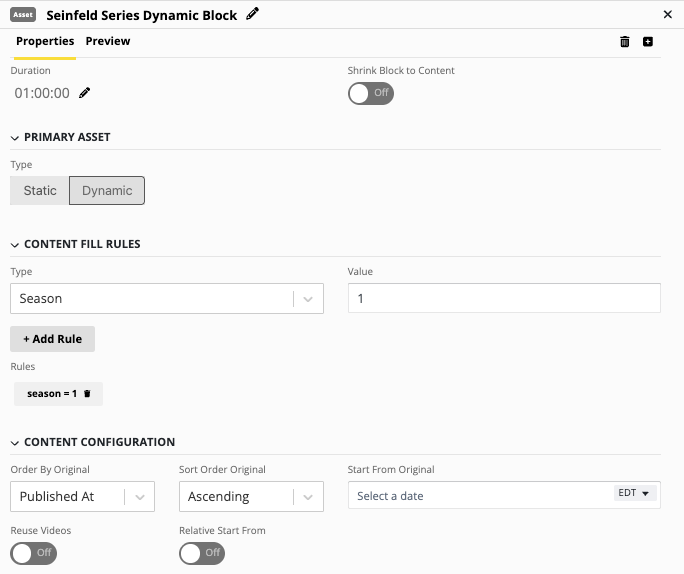
Teams can structure supporting content across:
- Pre-Fill segments that run before the primary asset
- Break segments that appear between programming sections
- Post-Fill segments that complete the remaining duration after the primary asset ends
Those segments can draw from playlists or content pools, giving teams a repeatable way to use approved promos, bumpers, ads, sponsorship assets, and other filler content.
The result is a controlled programming framework. Teams define the sources and rules. Zype Playout assembles the block.
Build Around the Program, Not the Leftover Time
The most useful shift is how teams approach the block.
Instead of starting with an awkward timing gap and trying to patch it, teams can start with the main programming experience and define how the surrounding airtime should behave.
A movie block might need a short brand bumper before the film, a promotional asset after it, and house ads to complete the scheduled duration. A sports replay might need sponsor messages around the main content. An episodic channel might need consistent pre-roll and post-roll promotion without repeating the same asset too often.
Dynamic Block Builder supports that type of workflow by letting teams build around the primary content and use rules to manage the remaining airtime.
The final block feels planned, not patched together.
Keep the Channel Fresh Without Constant Manual Updates
Automation only creates value when it protects the viewer experience.
A channel can reduce slate and still feel repetitive if the same promo appears too often. The schedule may be technically complete, but the experience starts to feel stale.
Dynamic Block Builder includes frequency caps to help manage how often filler content can be reused within a defined cooldown window. That gives teams more control over variety without requiring someone to manually inspect every block.
This matters for FAST and OTT channels that rely on promotional rotation, sponsorship delivery, and branded transitions throughout the viewing experience.
A promo should drive discovery. A sponsorship asset should support monetization. A bumper should reinforce the channel identity.
Used too often, each one loses impact.
By combining content pools with frequency controls, teams can automate more of the scheduling process while keeping the channel experience balanced and deliberate.
Preview What Will Actually Air
One of the biggest risks in linear scheduling is discovering a problem after the block is already live.
A gap appears. A filler asset repeats. A block does not come together the way the team expected. By that point, the issue is already visible to viewers.
Dynamic Block Builder helps reduce that uncertainty with preview capabilities that show how a block is expected to be composed before scheduling.
Teams can review upcoming iterations, identify potential gaps, and better understand how filler content will be distributed. That visibility is valuable for any programming team, but especially for operators managing multiple channels or high-volume schedules.
Previewing the block gives teams more confidence that the channel experience they planned is the one viewers will actually see.
Where Zype’s Playout Dynamic Blocks Fit Best
Zype’s Playout Dynamic Blocks are especially useful in workflows where programming blocks follow a repeatable structure but still need flexibility.
FAST channel operators can use them to reduce fallback slate and rotate promotional inventory more effectively.
Broadcasters can use them to manage station IDs, sponsorship messages, house ads, and promos around scheduled programming.
OTT teams can use them to create more consistent linear experiences across multiple channels.
Sports and event-based networks can use them to build repeatable programming structures around replays, highlights, interviews, and shoulder content.
In each case, the value is controlled automation. Teams decide which content sources are available, how blocks should be structured, and how often certain assets can appear. Zype Playout helps execute that logic more efficiently.
Smarter Blocks, Better Channel Experiences
FAST and linear streaming channels are becoming more sophisticated.
Programming teams are managing more content, more campaigns, more sponsorship requirements, and more pressure to keep channels engaging around the clock. Static scheduling alone cannot always keep up with that complexity.
Zype’s Playout Dynamic Blocks give programming teams a more practical way to manage the realities of modern linear scheduling: shifting runtimes, rotating promotional inventory, sponsorship requirements, and the need to keep channels feeling fresh.
By anchoring blocks around primary content, filling remaining airtime with approved content pools, applying frequency controls, and previewing compositions before scheduling, teams can reduce fallback slate while maintaining control over the viewer experience.
Ready to reduce fallback slate? Request a demo to see how Playout Dynamic Blocks can help your team build smarter programming blocks in Zype Playout.