

Metadata is one of the most important layers in any video platform. It drives discoverability, shapes user experience, and supports monetization.
Managing it is also one of the most manual processes in video operations.
For most streaming and media teams, metadata still relies on human input across every asset. Titles, descriptions, keywords, and genres are written, reviewed, and updated one video at a time. As libraries grow, this becomes a bottleneck that slows down publishing, creates inconsistencies, and limits scale.
Zype’s new AI-Powered Metadata Generation introduces a system-level approach to metadata, built directly into the Zype CMS and designed for teams managing large, distributed video catalogs.
What AI Metadata Generation Actually Solves
At a surface level, AI metadata generation automates the creation of titles, descriptions, keywords, and tags.
At an operational level, it solves a much larger challenge: keeping metadata consistent and scalable across growing content libraries, distribution endpoints, and video workflows.
In most environments, the breakdowns are familiar:
- Metadata gets added after ingestion instead of within the workflow itself
- Different teams follow different standards, creating inconsistencies across OTT apps and FAST channels
- Important fields get skipped or left incomplete, hurting discoverability and recommendations
- High-volume publishing periods create operational bottlenecks and slow time-to-publish
As distribution expands across OTT platforms, FAST channels, and web, these gaps become harder to contain. Metadata begins to directly influence not just organization, but performance.
When metadata is inconsistent or incomplete, content is harder to surface, harder to navigate, and less likely to engage viewers.
AI metadata generation shifts metadata from a manual publishing task to an integrated part of the video workflow, helping teams maintain consistency across large libraries and distribution environments.
For teams managing large video catalogs, that means faster publishing workflows, fewer operational bottlenecks, and more consistent content performance across platforms.
Introducing AI-Powered Metadata Generation in Zype
Zype’s latest release brings AI metadata generation directly into the CMS, allowing metadata to be generated as part of the publishing workflow.
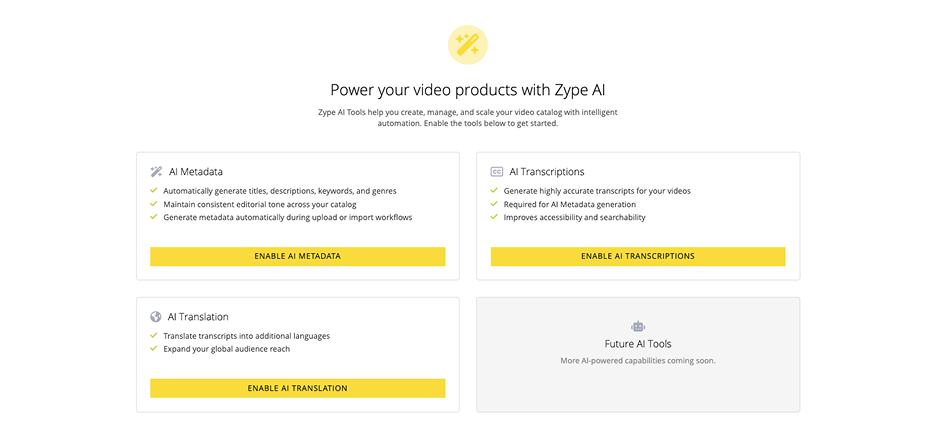
The system generates:
- Titles
- Long and short descriptions
- Keywords
- Genres
- Custom metadata fields
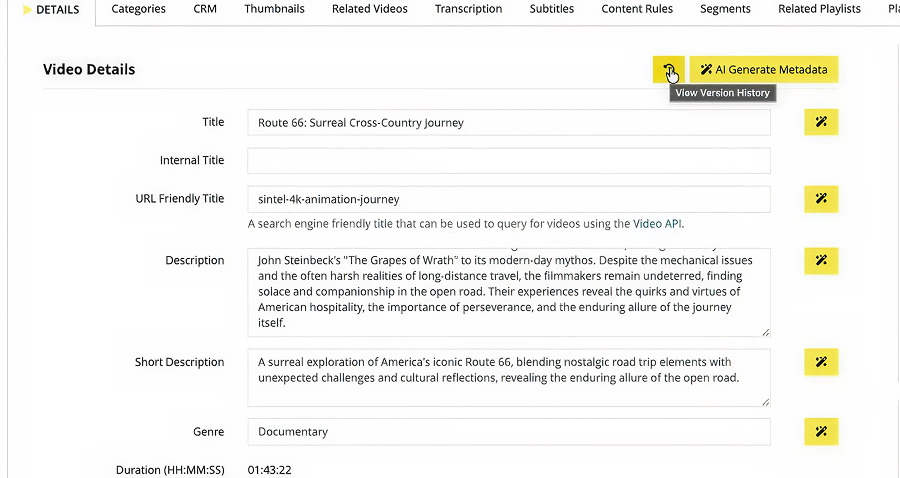
Each output is derived from the video’s transcript and shaped using team-defined inputs like brand guidelines, ensuring consistency across your video library.
This helps teams maintain more complete metadata across large catalogs without relying on manual entry for every asset.
How It Works Inside the Platform
Metadata generation starts with the video transcript.
AI Transcriptions convert video audio into text, which language models then analyze to generate structured metadata across key fields.
Outputs can also be guided using team-defined inputs like:
- Brand description and editorial guidelines
- Reference videos
From there, metadata can be generated in three ways:
- Per field on a single video
- In bulk across multiple assets
- Automatically during upload, import, or MRSS workflows
Teams can review outputs before applying changes, with version history available at the field level.
What Makes This Different from Basic AI Tools
Most AI tools can generate text. That alone does not solve the problem.
The challenge is applying it in a way that fits real publishing workflows while still giving teams control over the output.
Zype’s approach is designed around how video teams actually operate:
-
Built into the CMS: Metadata is generated directly within the CMS, without moving assets between systems or relying on external tools.
-
Transcript-driven outputs: Metadata is generated from the video transcript, helping keep outputs aligned with the actual content.
-
Brand-controlled generation: Teams can define tone, structure, and formatting guidelines to maintain consistency across their video library.
-
Bulk and automated workflows: Metadata can be generated across entire libraries or triggered automatically during ingestion workflows.
-
Review and version control: Teams can review outputs before applying changes, with field-level version history available when needed.
The result is a system that fits naturally into how modern video teams already manage and distribute content.
The Impact on Video Operations
For media companies, broadcasters, and OTT platforms, this shift changes how content moves from ingestion to distribution.
-
Faster time to publish: Metadata is created during ingestion, allowing content to move directly into scheduling and distribution without waiting on manual completion.
-
Stronger content discoverability: Consistent, structured metadata improves search, categorization, and recommendation systems across OTT apps, FAST channels, and web platforms.
-
Lower operational overhead: Teams are no longer writing metadata asset by asset. Effort shifts toward review and refinement instead of repetitive data entry.
-
Scalable global distribution: Multi-language metadata generation, powered by AI Translation, supports expansion into new markets without requiring separate workflows for each region.
Together, these workflows help teams publish and manage larger video libraries more efficiently across OTT, FAST, and web distribution.
Where This Fits in the Broader Shift to AI Video Workflows
Metadata is just one part of a broader shift happening across video operations.
Teams are increasingly looking for ways to standardize repetitive processes and automate more of the path from ingestion to distribution.
Zype’s AI Tools hub brings together:
- AI Metadata
- AI Transcriptions
- AI Translation
Because these capabilities are built directly into the CMS, teams can manage transcription, metadata, and localization within the same workflow they already use to manage content.
How to Get Started
Getting started only takes a few steps:
- Go to the AI Tools section in Zype CMS
- Enable AI Transcriptions
- Enable AI Metadata
- Configure brand settings
- Generate metadata on a video or across your library
Teams can also incorporate metadata generation into ingestion workflows so content is enriched automatically as it enters the platform.
For step-by-step instructions, see the help center article.
Still handling metadata manually? Zype helps video teams automate enrichment directly within the CMS. Request a demo to see how it works.